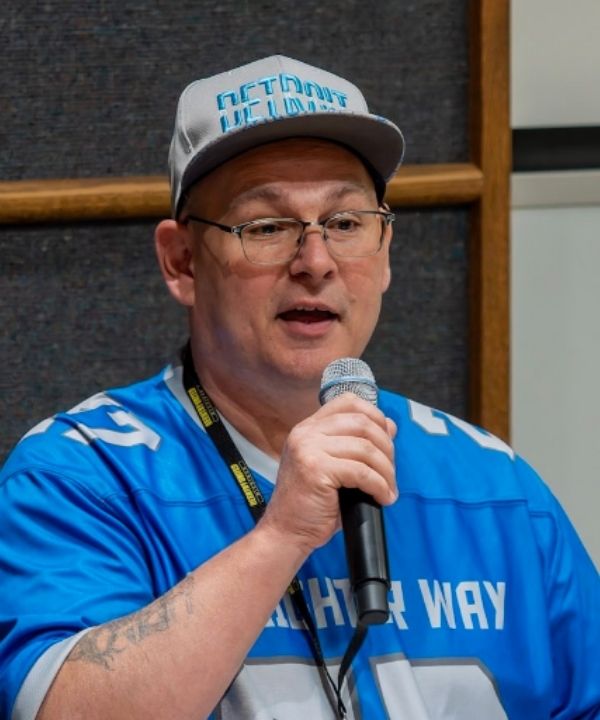
When Jennifer was released from prison in Michigan at age 38, she came home without financial support, carrying grief, stigma, and the immediate pressure to survive.
Jennifer was born and raised in Michigan, the oldest of three children. Her childhood was shaped by instability. Her father struggled with alcoholism, and her mother was diagnosed with schizophrenia when Jennifer was five years old. When her parents divorced at 13, Jennifer and her sister fell behind in school, and much of the responsibility for holding things together fell on her shoulders. Her father worked blue-collar jobs, and her mother stayed home. Jennifer learned early how to endure.
At 19, Jennifer was incarcerated following a tragic accident. She was released at 38, after spending nearly two decades locked up.
When Jennifer came home, she was placed in transitional housing. The conditions were worse than what she had experienced inside prison. Beds were soiled. Drugs were present. Furniture was broken. Safety was uncertain. She would spend two years there, trying to rebuild her life without money, stability, or meaningful support.
In Michigan, thousands of people are released from prison each year with little to no assistance, even though the first weeks after release are often the most fragile. With no means of income, people struggle to secure transportation, food, communication, or basic documents. For Jennifer, the absence of income support shaped every decision she made.
Within two weeks of her release, Jennifer found seasonal work doing landscaping at a cemetery. She had earned a horticulture degree while incarcerated and described herself as having a green thumb. What helped her get the job was honesty. She joked that everyone there was already dead and she would not hurt anyone. The humor broke the tension, and she was hired. The job paid $15 an hour, but it was temporary.
Jennifer’s parole officer referred her to a workforce office for help finding employment. Through that process, she was sent to interview with an employer in east Detroit, as well as referred to other job opportunities. During one of those interviews, the woman she met with looked at her computer, then back at Jennifer, and told her she did not have positions for “murderers.” She did not ask Jennifer about her conviction or her circumstances. Jennifer had to remain composed because she was on parole and could not speak freely.
After that encounter, Jennifer stopped asking for help. She applied to fast food restaurants and other places and was denied repeatedly.
Eventually, she found work at a factory assembling COVID test kits, a place where background checks were less of a barrier. The job paid $19 an hour, but it was far from home. Public transportation required her to leave home four hours early, often riding buses at two or three in the morning. For a woman traveling alone at that hour, it was risky. But she needed the income.
The lack of income meant Jennifer was always making decisions based on survival. Maintaining a cell phone was difficult. Transportation was fragile. She had no cushion for rejection and no margin for error.
Jennifer’s current role came through a training opportunity where the only requirement was that participants be formerly incarcerated. Ten people entered the training for eight potential positions. The program offered two weeks of paid training with no guarantee of a job. The day Jennifer completed the training was also the day she officially came off parole. A few weeks later, she was hired as a peer navigator at A Brighter Way, an organization that supports people impacted by incarceration.
Jennifer has now been with A Brighter Way for three years. She currently serves as the Tri-county Director.
Looking back, Jennifer is clear about what was missing when she came home. Without gate money or reentry cash, she believes she could have been better prepared for rejection, better supported in her job search, and less consumed by survival. Even maintaining a cell phone was a challenge. Financial support would not have erased the barriers she faced, but it would have given her room to plan and recover when doors closed.
Jennifer’s experience highlights how difficult reentry can be without financial support. Today, she leads, supports others, and helps people navigate the very systems that once shut her out. Her story shows what reentry looks like when people are expected to rebuild without a financial foundation.