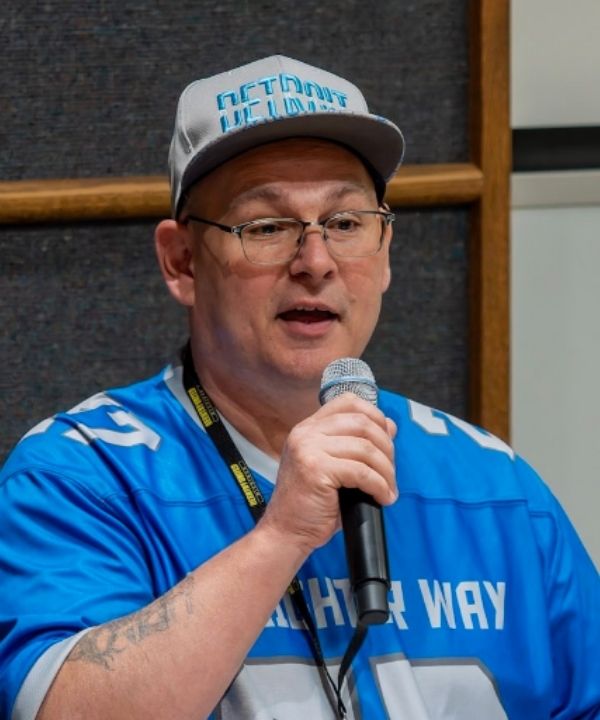
When Adam walked out of prison on January 8, 2020, he was returning to a world that looked very different from the one he left. He was 49 years old, coming home to Michigan with determination, preparation, and one critical thing many people leaving prison do not have: ability to meet basic needs.
Adam grew up in Lansing, born in 1970 to very young parents whose marriage ended early. His childhood was shaped by poverty, instability, and a revolving door of adults in his life. By the time he was 12, Adam had committed his first armed robbery and got into trouble several times after. At 19, he went to jail for the first time. The last time he was incarcerated, Adam was 22 years old. He would not be released again until he was 49, spending the majority of his adult life locked up. When he came home, he often joked that he felt 19 and 49 at the same time, the age he first went in and the age he was when he returned home.
Adam’s release came just weeks before the COVID pandemic shut down the country. The timing made reentry even harder. Although he had trained as a peer recovery coach while incarcerated, job offers were rescinded once employers learned how much time he had served. He later found work at a homeless shelter and as a canvasser, but both jobs ended when the pandemic hit. Because he was asked to quit, he did not qualify for unemployment benefits.
Even with those barriers, Adam says he came home prepared. He had done his research. He had built habits. He was motivated not to become another statistic. “Practice doesn’t make perfect,” he says. “It makes permanent.” When he was released, the biggest change was not his mindset. It was his environment.
What made the difference in those early days was something deceptively simple: money in his pocket.
Adam’s gate money did not come from the state. It came from his mother-in-law, who quietly set aside what she called “cookie money” over five years. Every time she resisted buying cookies, she put the money away for Adam. When he came home, that small fund became his financial foundation.
The first things he used it for were basic but essential. He paid for his driver’s license. He bought his own meals. He learned how to budget. For the first time in a long time, he could take care of immediate needs without asking permission or relying on someone else.
That freedom mattered.
In Michigan, as in many states, people are often released from jail or prison with little or no support, even though the first days and weeks after release are the most unstable. Without access to any income, people struggle to secure identification, transportation, food, housing, or even show up to job interviews. These barriers have little to do with motivation or character. They are structural.
For Adam, having money gave him the ability to take risks others told him not to take. He applied for jobs people said he had no business applying for because of his record. He accepted a part-time peer recovery coach role at $14 an hour and kept searching for something better. That persistence led him to a position as the Jackson Area Recovery Community Coordinator with Home of New Vision, where he was told during his interview that he was “a miracle” and offered a full-time role with benefits. He was expected to be a leader. That opportunity opened doors that had not been available to him before.
Adam is now the Chief Executive Officer of A Brighter Way, an organization dedicated to supporting people impacted by incarceration. He is also an advocacy fellow and has been invited for keynote speaking engagements. None of this happened overnight, and none of it happened without support in those early days.
Yet even now, barriers remain. Housing continues to be one of the most persistent challenges. Adam is still not on his lease. When he and his wife tried to move into an apartment above his mother-in-law, the unit was approved based on his wife’s information. Once the landlord requested that Adam complete an application and his background check came back, the approval was rescinded. It was a reminder that reentry does not end once someone finds a job or builds stability.
Adam describes having access to income during reentry as a safety net, “like a warm blanket in a cold place.” It made him feel cared for and not alone. It allowed him to participate in everyday life, like taking his niece and nephew somewhere and being able to pay. Most importantly, it helped him feel less like an outsider and more like a normal participant in his community.
When he talks about those first months, Adam says he’s not sure he would have ended up in the same rooms or relationships without income support. Having money allowed him to move through those early days with confidence and independence, rather than relying on others for every decision.
Today, Adam is building a life rooted in leadership, advocacy, and service. That foundation was laid in his earliest days home, when having income allowed him to move through the world with confidence and dignity. It did not change who he was. It changed what was possible.