Access to food is not just a safety net — it is a prerequisite for work, stability, and public safety. As CEO works to build a stronger reentry system through Opportunity 2030, SNAP and SNAP Employment & Training play a critical role in ensuring people can stabilize quickly and move toward long-term economic mobility.
Food Security Shapes Opportunity
Each year, more than 600,000 people return home from incarceration. In the weeks and months following release, food insecurity is one of the most immediate and destabilizing challenges people face.
SNAP — the Supplemental Nutrition Assistance Program — is the nation’s largest and most effective anti-hunger program. It provides critical food support to tens of millions of Americans, including many people returning from incarceration who are actively seeking work.
For justice-impacted individuals, access to SNAP:
- Stabilizes basic needs during the job search
- Reduces crisis-driven decision-making
- Improves engagement in employment and training
- Supports public safety and successful reentry
Yet despite eligibility, many returning individuals lose access to SNAP precisely when they begin working or training — at the moment stability matters most.
Through Opportunity 2030, CEO is focused on strengthening the systems that support successful reentry at scale. Food security is foundational to that effort. Without reliable access to food, returning individuals cannot consistently participate in training, stabilize their lives, or move toward long-term employment.
SNAP is not peripheral to reentry success — it is one of the first building blocks of opportunity.
Connecting Food Support to Work
SNAP Employment & Training (E&T) helps SNAP recipients gain skills, work experience, and credentials that lead to long-term employment and self-sufficiency.
In the 2018 Farm Bill, Congress strengthened SNAP E&T by allowing paid work-based learning, subsidized employment, and transitional jobs — recognizing the strong evidence behind paid training for people with high barriers to employment.
CEO operates SNAP E&T programs across multiple states and is a national leader in helping states and community-based organizations design, implement, and scale SNAP E&T models that work for justice-impacted people. This work aligns with CEO’s broader Opportunity 2030 goal of building durable reentry employment pathways.
CEO's SNAP E&T programs pair the following:
- Immediate paid work experience
- Career coaching and credential pathways
- Retention support after job placement
This approach works. Independent evaluations show CEO participants are significantly more likely to be employed long-term and less likely to return to incarceration.
When SNAP E&T functions as intended, it serves as a bridge from food security to workforce participation — reinforcing the connection between short-term stability and long-term self-sufficiency.

The “Work or Eat” Catch-22
The Challenge
Successful reentry depends on systems that work together — not at cross purposes.
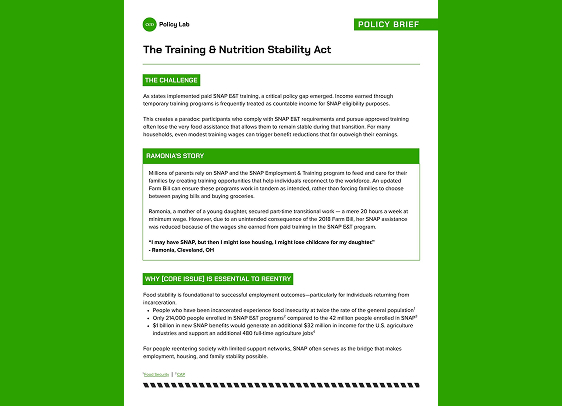
As states implement paid SNAP E&T programs, an unintended consequence has emerged. Temporary wages earned through SNAP E&T are counted as income when determining SNAP eligibility.
As a result, people can lose their food benefits because they are participating in job training funded by SNAP itself.
This forces an impossible choice:
- Continue job training and lose food assistance
- Or keep food assistance and leave the training program
This policy contradiction:

Discourages participation in evidence-based training

Increases program drop-off

Undermines workforce outcomes

Weakens return on taxpayer investment
For people returning from incarceration — who already face barriers to employment, housing, and transportation — this cliff can derail progress at the most fragile point in reentry.
Recognizing this challenge early, CEO began organizing partners, practitioners, and policymakers around the need for a legislative fix.

Think Pieces
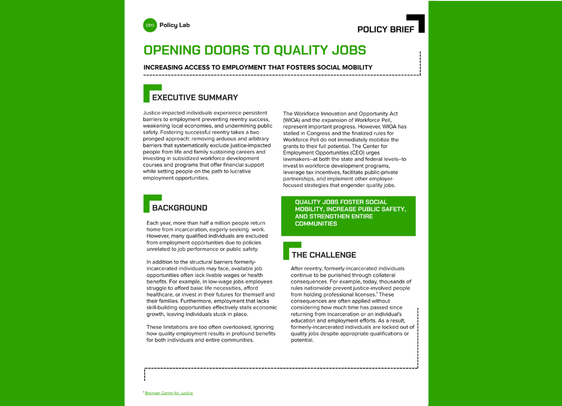
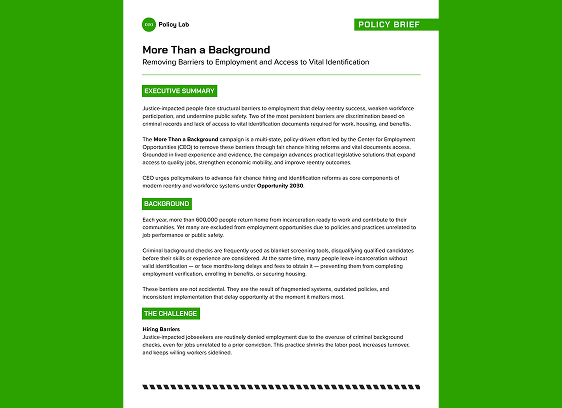
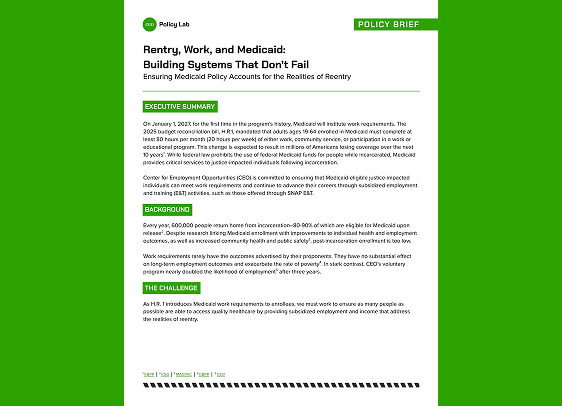
Policy Briefs
.png)
.png)
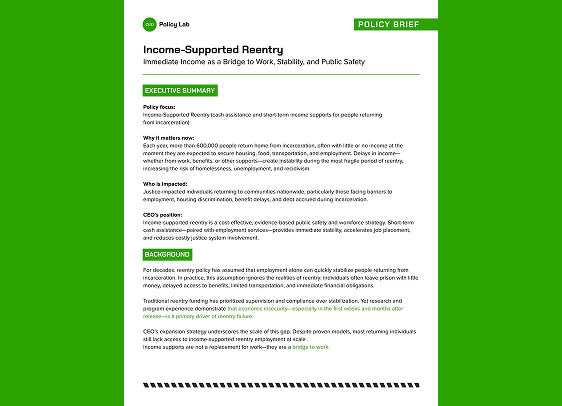
Policy Priorities
CEO is leading the national effort to advance the Training & Nutrition Stability Act (TNSA) and serves as the central convener of the We Can’t Wait Coalition — a broad, bipartisan coalition of anti-hunger organizations, workforce providers, reentry organizations, food banks, faith groups, and advocates from across the country. CEO’s policy advocacy focuses on aligning food security, workforce development, and reentry systems so they reinforce — rather than undermine — one another.
Through the We Can’t Wait Coalition, CEO brings together diverse stakeholders to elevate lived experience, coordinate advocacy, and push for common-sense reforms that ensure SNAP and SNAP E&T work as Congress intended. As part of its Opportunity 2030 strategy, CEO ensures that lessons from the field — from participants, employers, and frontline providers — inform federal policy.
Maintaining Eligibility
A bipartisan bill advanced by CEO and the We Can’t Wait Coalition that fixes a technical flaw in SNAP law by ensuring temporary wages from SNAP E&T and other federally funded job training programs are not counted against SNAP eligibility.

Coordination
So SNAP supports — rather than disrupts — pathways to employment.

Removing Barriers
Repeals the lifetime SNAP ban for individuals with felony drug convictions, expanding access to food assistance and job training during reentry.
Training
That prioritize paid work-based learning, credential attainment, and employer engagement.
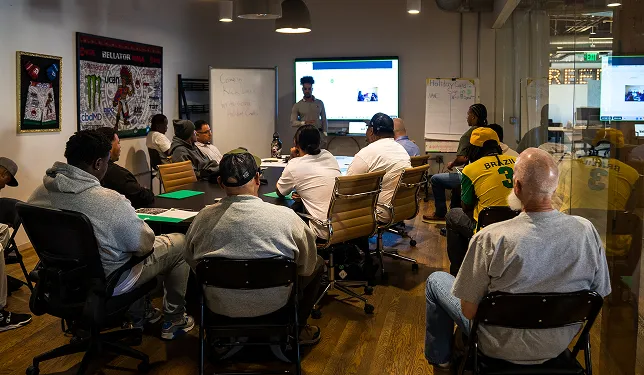
These reforms are essential to ensuring SNAP and SNAP E&T function as effective components of a modern reentry system.
A Vision for What's Possible
With the right policies and systems in place, SNAP and SNAP E&T can:


Support
Support families during critical transitions

Increase
Increase long-term employment and earnings


Strengthen
Strengthen local labor markets

Deliver
Deliver strong returns on taxpayer investment

By advancing reforms like the Training & Nutrition Stability Act and the RESTORE Act through the We Can’t Wait Coalition, CEO is helping ensure that food assistance and workforce programs work together to support reentry success nationwide.
Help Build a Reentry System That Works
Policymakers, philanthropy, employers, advocates, and community partners all have a role to play in ensuring food security supports — rather than undermines — economic mobility.
Join CEO and the We Can’t Wait Coalition in advancing Opportunity 2030 and modernizing SNAP and SNAP E&T — so no one has to choose between meeting basic needs today and building a better future tomorrow.