Immediate income is not a luxury in reentry — it is a stabilizing force that allows people to meet basic needs, engage in employment and training, and avoid crisis-driven decisions. For individuals returning from incarceration, immediate assistance and income earned through paid training is often the difference between dropping out and completing a pathway to a quality, high-wage job. As part of Opportunity 2030, CEO is working to make income support a core pillar of America’s reentry infrastructure.
Stability Shapes Outcomes
Each year, more than 600,000 people return home from incarceration. In the first days and months after release, individuals are expected to secure housing, food, transportation, identification, and employment — often with little or no money.
Most states provide minimal “gate money,” frequently $40–$200, an amount that does not reflect today’s cost of living. Without immediate income, returning individuals face heightened risks of homelessness, food insecurity, and reincarceration.
Without income, returning individuals are forced to make crisis-driven decisions that can derail job search, training participation, and long-term stability. Income-supported reentry addresses this reality directly by ensuring people have access to earnings—and, where appropriate, short-term income supports—while they build skills and reconnect to the workforce.
Income-supported reentry:
- Stabilizes basic needs during the most vulnerable transition period
- Reduces reliance on emergency services and crisis responses
- Supports participation in employment and training programs
- Improves public safety by reducing technical violations and recidivism
Income support is not a substitute for work — it is what makes work possible.
Work-Based Income Supports Stability
Traditional unpaid training models often fail people returning from incarceration — not because they lack motivation, but because unpaid participation is financially impossible without other forms of income or support.
Paid training and transitional employment allow returning individuals to:
- Meet basic needs while building skills
- Remain engaged in training programs long enough to complete them
- Gain real work experience that employers value
- Transition more quickly into unsubsidized employment
For justice-impacted people, earning income while training is not a bonus — it is a prerequisite for economic mobility and long-term success. But economic mobility requires access to quality jobs that pay family-sustaining wages and offer advancement opportunities. For many participants, advancing to these jobs requires industry-recognized credentials and specialized training.
CEO supports paid advanced training pathways that allow participants to earn income while completing certifications in high-demand fields, and through stipends and paid work-based learning, participants are able to complete advanced training without sacrificing financial stability.
Participants who combine transitional employment with advanced training show higher job retention rates, increased wages, and stronger long-term attachment to the workforce.
Cash assistance, when delivered early and paired with services, accelerates reentry success.

Too Little, Too Late
The Challenge
Despite growing evidence, most reentry systems still rely on outdated and insufficient income supports
Current challenges include
- Gate money amounts that do not cover even a week of basic expenses
- Long delays before individuals can access public benefits and transitional assistance
- Lack of paid training opportunities in the workforce system
- Policies that treat income support as a risk rather than a tool for stability
Without immediate income, people are forced into impossible choices — between food and transportation, housing and job search, compliance and survival.
This instability increases the likelihood of technical violations, reincarceration, and long-term reliance on public systems.
Think Pieces
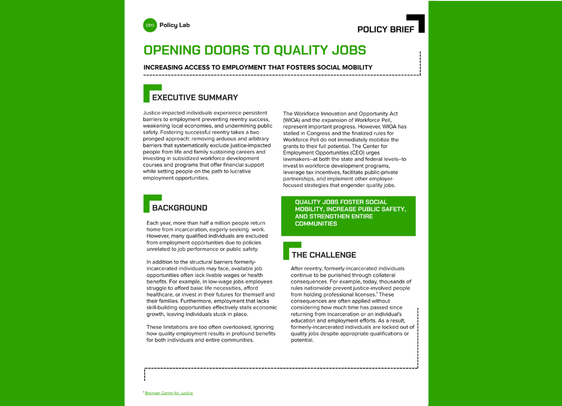
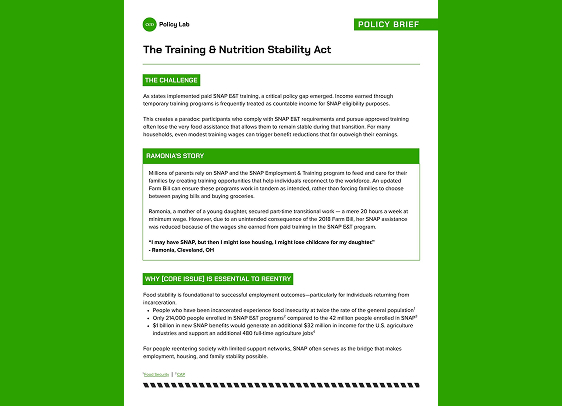
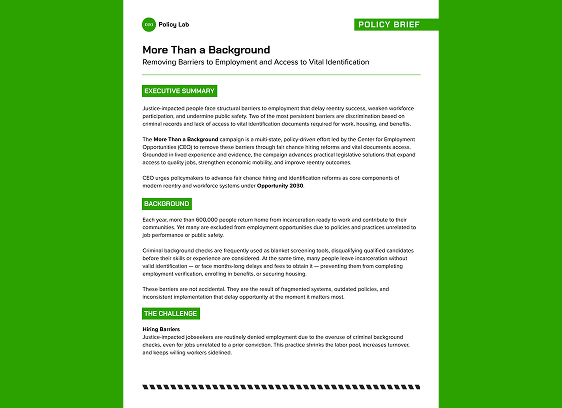
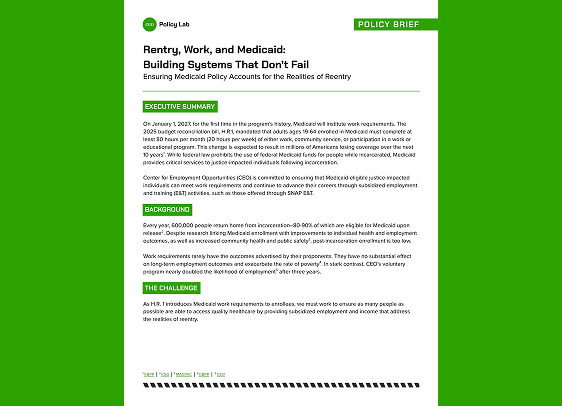
Policy Briefs
.png)
.png)
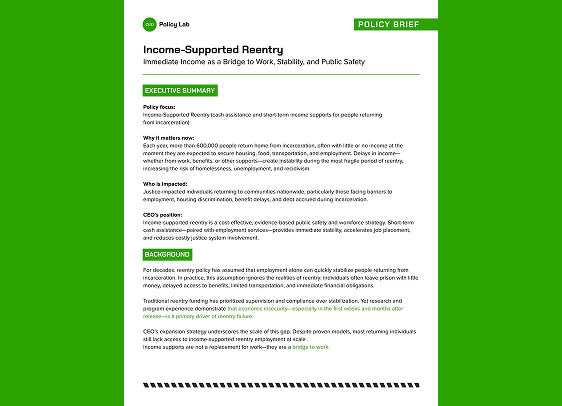
Policy Priorities
This work across states builds directly on evidence from CEO’s Returning Citizens Stimulus (RCS) program, which demonstrated that short-term cash assistance, when delivered immediately after release, improves stability and reduces justice system contact. Under Opportunity 2030, CEO is translating those lessons into durable, scalable policy — embedding income support into reentry and workforce systems as a core component of the reentry infrastructure needed to support all 600,000 people returning home each year.
CEO’s current priorities center on three states where this work is most advanced:
California
In California, CEO is a leading partner in the Helping Justice-Involved Reenter Employment (HIRE) initiative — a state-funded workforce program that pairs employment services with stipends and needs-based assistance for people returning from incarceration.
Through CEO’s work, the HIRE initiative:
- Individuals can receive approximately $2,400 in short-term cash assistance to cover essentials like food, transportation, housing costs, and job-related expenses
- Payments are delivered alongside workforce services, including paid training, career coaching, and job placement
- Cash support helps participants remain engaged in employment pathways and avoid destabilizing setbacks during reentry
CEO helped shape the design of HIRE based on lessons from the Returning Citizens Stimulus and now supports implementation through direct service, partner coordination, and technical assistance. With recent changes to California’s criminal justice landscape increasing the urgency of reentry support, CEO continues to advocate for sustained and expanded investment in HIRE as a core component of the state’s workforce and reentry strategy.

Colorado
In Colorado, CEO and partners are actively advancing legislation to establish reentry cash assistance pilots that provide short-term income support tied to workforce participation.
CEO’s work in Colorado focuses on:
- Advancing legislation that would protect gate money and broaden eligibility
- Educating lawmakers on evidence from the Returning Citizens Stimulus and other cash assistance models
- Aligning cash assistance proposals with existing workforce and reentry programs
- Building durable bipartisan support to move legislation across the finish line
This effort reflects CEO’s commitment to sustained policy engagement and long-term systems change — recognizing that durable reentry reform often requires multiple sessions and continued coalition-building.

New York
In New York, CEO is a leading architect and advocate for the Reentry Assistance Bill, landmark legislation that would modernize the state’s outdated “gate money” system and establish a meaningful, evidence-based standard for reentry support.
New York has made incremental progress in recent years by increasing gate money amounts, reflecting growing bipartisan recognition that the current system is insufficient. The Reentry Assistance Bill represents the next and necessary step: moving from symbolic increases to a modern reentry infrastructure that aligns resources with real-world costs and expectations placed on returning New Yorkers.
The bill would:
- Provide $2,550 in time-limited cash assistance to people released from state prison, delivered in structured monthly payments
- Replace one-time, inadequate gate payments with sustained support during the critical first months after release
- Help individuals meet essential needs — food, transportation, housing costs, identification, and job preparation — while pursuing employment and training
This legislation builds directly on evidence from CEO’s Returning Citizens Stimulus (RCS) program, which demonstrated that short-term cash assistance, when delivered immediately after release, improves stability and reduces justice system contact. The Reentry Assistance Bill translates those lessons into permanent policy.
CEO is working alongside a broad statewide coalition of service providers, advocates, local governments, and people with lived experience to advance the bill. With strong momentum and growing legislative support, New York is positioned to lead the nation in demonstrating how reentry cash assistance can function as a public safety, workforce, and economic mobility strategy.
Across all three states, CEO’s approach is consistent: use evidence to move policy from theory to practice, ensure income support complements work, and build durable models that can be sustained and scaled.
A Vision for What's Possible
With the right policies in place, income-supported reentry can:


Improve
Improve employment and earnings outcomes

Strengthen
Strengthen housing and family stability


Lower
Lower correctional and emergency system costs

Deliver
Deliver strong returns on taxpayer investment

CEO’s experience shows that modest, time-limited investments at the front end of reentry produce lasting benefits for individuals, families, and communities.
Help Build a Reentry System That Works
Policymakers, philanthropists, advocates, and partners all have a role to play in modernizing reentry.
Join CEO in advancing Opportunity 2030 and building income-supported reentry systems that recognize a simple truth:
People succeed when they have the stability to do so.