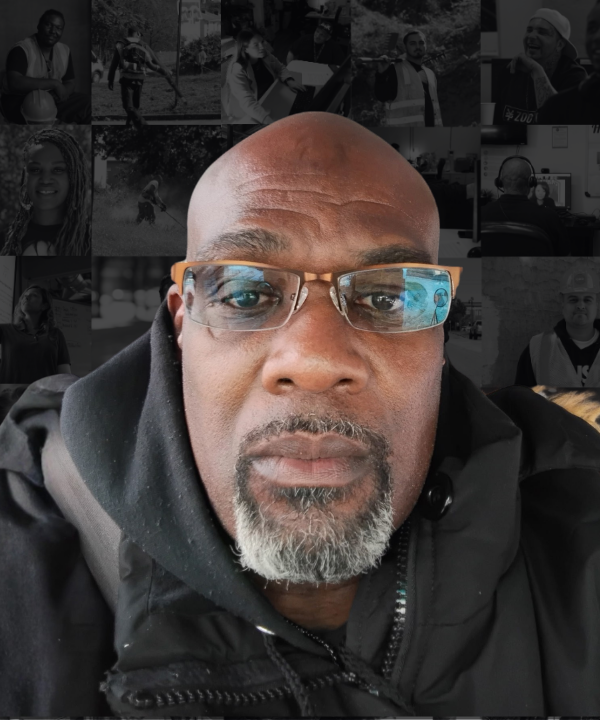
When Dion walks through the east side of Detroit on his way to work, it’s not just another commute – the 56-year-old is walking on a sidewalk that he was never meant to walk on again; was hearing sirens that he was never meant to hear again.
Dion served 38 years of a life sentence before being released from a Michigan correctional institution 14 months ago. His journey from an upper‑class childhood to incarceration, and now to a life of service and mentoring, is one of remarkable transformation.
Born and raised in Detroit with four siblings and a large extended family, Dion grew up surrounded by love and opportunity. He attended private school, boxed, and played baseball. But by his late teens, he wasn’t happy with the academic classes at his high school and transferred to a school-sponsored vocational program where he learned mechanics, welding, and auto repair.
“I’ve always liked taking things apart and putting them back together,” Dion says. “I didn’t feel challenged in prep school and needed something different.”
But vocational school did not challenge Dion either, and that boredom would soon turn to something he felt more exciting as he and his friends began selling drugs. It was on the streets, chasing the fast money from drug sales, where Dion would meet his fate.
Dion explains that at only 18 years old, he was arrested for drug dealing and homicide and sentenced to life in prison. “My life ended before it ever really began,” says Dion. “I was just a kid making grown-up mistakes and it cost me everything.”
The early years were difficult – anger, regret, and shame dominated his thoughts. For a decade, Dion did anything he could to survive the gauntlet of life inside; however, when he turned 30, something inside of Dion changed. He yearned for more.
Dion began to transform his thinking and actions and seek self-help. He stopped getting disciplinary reports and enrolled in communication and substance‑use classes, volunteered as a mentor, and helped lead programs that taught other incarcerated individuals about accountability and personal growth.
“It’s about living as an example,” says Dion. “If people see you doing right, they’ll start to believe they can, too. Men respected me because of how I walked. I was a spiritual leader as well as a mediator on the yard and in the block.”
For two more decades, Dion used the clout he had inside to influence others to do good, and in 2025, a judge resentenced him and reduced his punishment to 38 years time-served. After almost four decades behind bars, Dion walked out a free man.
“Reentry was a blessing and a curse,” says Dion. “Simple things like learning technology and talking to new people were sometimes difficult. And no one wanted to hire me because of my record. I needed a purpose.”
That’s when the Center for Employment Opportunities (CEO) came in. Dion had learned about the reentry organization while in prison, and was referred to join the program. Dion felt more comfortable and joined a transitional work crew, working in a local hospital. He also attends a mental health group for formerly incarcerated people.
“CEO helped me a lot,” says Dion. “They gave me work clothes and boots, a bus voucher, and helped me apply for Supplemental Nutrition Assistance Program (SNAP) benefits, which helped me with food costs.”
After his job coach recommended an advanced training pathway for a commercial drivers license (CDL), Dion took an assessment test, passed his CDL permit test, and enrolled in trucking school, a 4-week intensive training course where he would learn to operate and drive semi-trucks safely. CEO paid the tuition and gave Dion a stipend to help with living expenses.
“I don’t know how to express how much the staff at CEO helped me to get through a difficult reentry,” Dion says. “I tell new guys they have to allow the program to work for them. You have to put aside your ego and let CEO show you some things.”
Dion did the work to graduate from trucking school with his CDL, but faced hiring discrimination and could not find a job driving trucks afterwards. Detroit is a fair chance city, meaning many employers looked past criminal histories to the real skill-sets and essence of a job-seeker; nonetheless, no one would hire Dion.
Having a commercial drivers license opens up a window of opportunity in the US. The American Trucking Associations reports the industry faces a long‑term shortage of nearly 80,000 drivers nationwide, with CDL holders earning an average of 25% more than non‑CDL drivers in similar transport jobs.
Eventually, Dion was picked up by a transportation company that hires justice-impacted individuals. He drives Detroit students to schools in nearby neighborhoods, forming bonds with the kids he serves. He says that he loves his new job and that the rewards are beyond description.
“Everyday one of these kids surprises me and makes me laugh,” Dion says.
Dion wouldn’t think of working anywhere else now. “I love the job and it pays well, but financial struggles still exist. When my SNAP benefits were dropped last January, that had a big impact on my income and what I could afford,” Dion says.
When his food assistance benefits were cut from $280 to $25 per month, Dion would not have had any money for food if he hadn’t gotten a second job doing Door Dash to pay for groceries. “Losing the SNAP benefits almost made me stop eating,” Dion says. “You can’t pay rent and eat at the same time.”
Through it all, Dion remains thankful – and determined. Living with his longtime sweetheart and reconnecting with family has kept him grounded. His message to others returning home is simple but powerful: “You’ve got to let the program work for you. They offer opportunities, but you have to do the work yourself.”
Stay connected—sign up for our newsletter to learn how CEO supports justice-impacted individuals through career building, advocacy, and policy change. Check out more stories on our blog or donate to support economic mobility.

