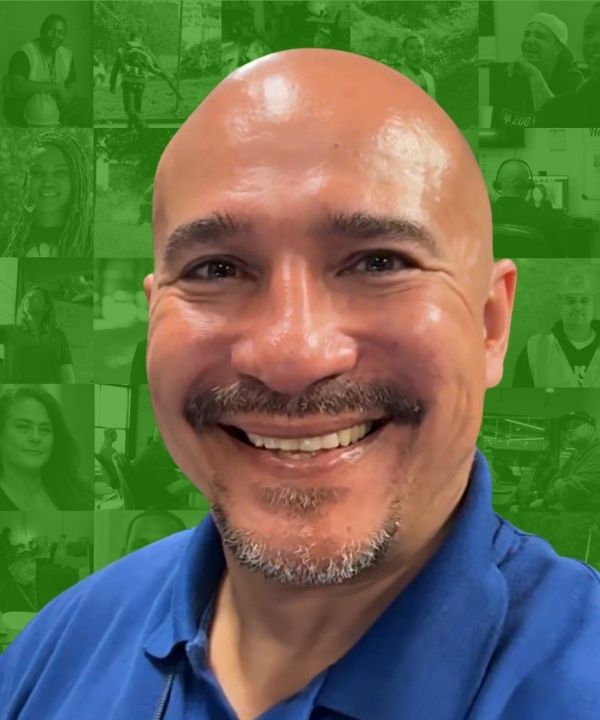
Every day, Angel helps unhoused individuals navigate some of the hardest times in their lives. As a behavioral health peer specialist for Sacramento County’s Homeless Engagement and Response Team (HEART), he connects people to food, medical assistance, and mental health services, and helps them find housing and shelter resources. Most importantly, he shows them that change is always possible.
“People in these tough situations have often lost that spark, that belief that things can change for the better,” Angel said.
“But I’m living proof that if you focus and take things one day at a time, you can get that spark back and turn your whole life around.”
Growing up in South Central Los Angeles in an unstable, under-resourced home and community, Angel became involved in gangs and crime at a young age. His choices led him first to juvenile hall, then jail, and finally, in 2002, to prison with a sentence of 15 years to life. During his time inside, he received the education he says saved his life.
“I had been in gangs and surviving on the streets since the age of 14, and because of that, I thought I was grown,” he said.
“But when I went to prison, I finally realized what I was doing to myself. I distanced myself from bad influences and bad habits, and really made an effort to change.”
During his 24 years incarcerated, Angel earned five associate's degrees and a bachelor’s in communications studies. He joined support groups like Alternatives to Violence, an experiential workshop program designed to teach conflict resolution, emotional management, and nonviolent communication, and attended Alcoholics and Narcotics Anonymous meetings. He also got a job in a volunteer education program, helping others fill out applications for their own college courses, offering tutoring and peer support, and serving as a mentor to younger generations entering prison after him.
“When they first got to prison, there was no one telling them to do good, or even what to do at all,” Angel said.
“I showed them that they could get an education, get job training, and maybe even earn time off of their sentences. I showed them that they had options.”
The work inspired his passion for helping others and became the first step toward his current career.
“I knew I was on a positive path, so I just kept walking,” Angel said.
When he was released in 2025, his longtime girlfriend and best friend, Mari, was the first to help along the way. She arrived with fresh clothes, taught him to use a new phone, and drove him to a transitional housing program he’d researched during parole prep. She also provided a sympathetic ear and level head whenever adjusting to life on the outside after nearly three decades behind bars became overwhelming.
“Getting out after so many years, being put back in charge of your life when everything you knew, from the technology to how people communicate, has changed, is stressful,” Angel said.
“Mari was always there to hear me out and help me to clear my mind.”
Studies show that the emotional support of loved ones, such as encouragement, reassurance, and understanding, can help individuals cope with the psychological distress associated with reentry and build the foundation necessary for continued success on the outside. Thanks to Mari’s support, Angel was able to maintain his focus and continue pushing forward.
He attended job fairs and applied to employment opportunities across the city. Through his housing program, he connected with the Center for Employment Opportunities (CEO) in Sacramento and secured transitional employment beautifying highways. The work provided much-needed initial financial stability, helping him cover essentials and establish savings. Angel also received one-on-one job coaching and application assistance, which boosted his confidence and helped him stand out as a candidate.
“The more I participated in office days and worked with the job coach, the more knowledgeable I became about sending out applications, writing cover letters, and just being ready and prepared for job interviews,” he said.
Meanwhile, on the work crews, he set the standard, making sure to be one of the first to arrive at the start of the day and the last to call it quits when the shift was over. At the office, he took initiative and welcomed new applicants, helping them navigate the computers used to look for jobs, fill out applications, and send emails. He lent a hand whenever and wherever it was needed, and, as a result, earned a spot in the Emerging Leaders Program (ELP), a 16-week paid internship that provides hands-on experience and professional development for individuals pursuing careers in the human and social services field.
In the ELP, he continued to work in the office, handling applicant intake, orientation, and using his skills and talents as a mentor to listen and motivate by example. It was his experience and time in the program, and at CEO in general, that he says finally helped him to realize what he wanted to do with his life.
“The work at CEO, showing people like me that change is real and that, with time and patience, they could be exactly where I was sitting, gave me purpose,” Angel said.
“I knew that I wanted to be there for others like me who needed help elsewhere.”
However, nearly 90 percent of large companies conduct employee background checks, and many are unwilling to hire someone with a criminal record. Studies show that having a conviction history reduces employer callback rates by 50 percent. For Angel, finding a job that aligned with his career goals and values wasn’t easy, and he says he encountered more than a few closed doors.
“I had been going to job fairs, and my first question for any employer was always, ‘Do you believe in second chances?’” Angel said.
“A lot of them said no.”
Then he connected with the team at Sacramento County, who listened to his story, assessed his qualifications, and urged him to apply for the available peer specialist role as soon as possible. Just one interview later, they said yes, and the job was his.
“Not thirty minutes after my interview, they called me back and offered me the position,” Angel said.
“They told me I was exactly who they wanted.”
Today, Angel has a car, a stable income, and a career that not only offers future advancement opportunities, but really matters to him. He wants to one day be a case manager and take on a larger role in shaping how his team engages with individuals in need. While he still lives in transitional housing, he plans to own a house in five years and, thanks to his passion for mentorship, is currently volunteering as the house manager of his unit, managing the household, supporting his peers' educational and vocational goals, and enforcing house rules.
Meanwhile, every day he goes to connect unhoused individuals with aid and support, he offers people tangible proof that investing in yourself works.
“There are so many people on parole just like me who are unhoused and think they can’t get a job and a place to live because they have a criminal record,” Angel said.
“I tell them, ‘I’m on parole, I spent 24 years in prison, look at me now,’ and I watch their eyes light up because in that moment they realize that they can do it too.”
Stay connected—sign up for our newsletter to learn how CEO supports justice-impacted individuals through career building, advocacy, and policy change. Check out more stories on our blog or donate to support economic mobility.