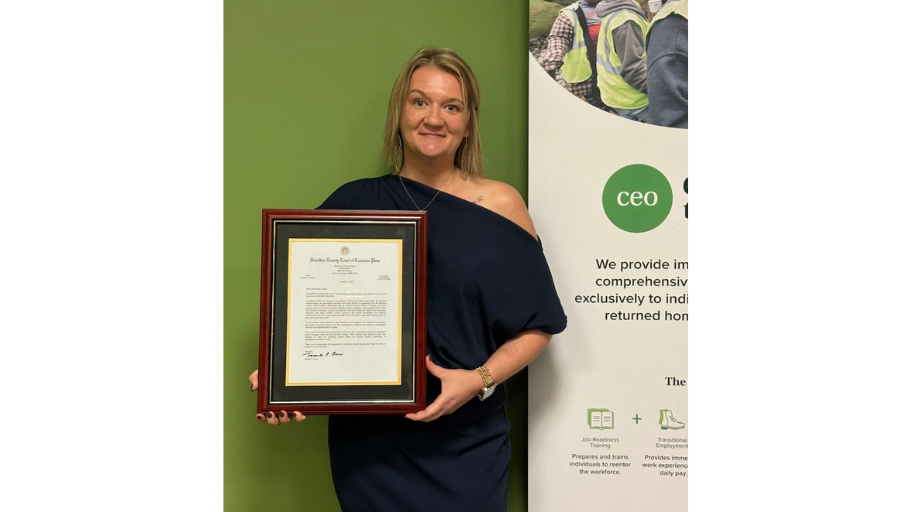
Every time Courtney, director of the Center for Employment Opportunities (CEO) in Cincinnati, shuts her computer and leaves work after a day spent leading her team, building relationships, and helping formerly incarcerated individuals find work and gain economic stability, she’s reminded of the value of a fair chance.
Today, Courtney’s leadership and lived experience inform conversations about reentry that extend beyond her own site and into the broader Cincinnati community.
“When people ask me how I can drive three hours round trip to work every day, from Kentucky to Ohio and back, I tell them it is because I love what I do,” she said.
“I tell them that at CEO we’re changing someone's life everyday.”
For Courtney, who began her journey with CEO Cincinnati as a program participant, the work is deeply personal. Being able to support people facing the same struggles she once did, remind them that a better life is possible, and share the tools to get there is what makes even the hardest days worth it.
Over 70 million Americans with arrest records face barriers to finding work or a decent place to live, suffering a 27 percent unemployment rate and regular housing discrimination. In 2024, CEO helped nearly 7,500 just-involved individuals build new career paths, provided $19.3 Million in wages, and placed roughly 3,900 people in permanent employment.
“One of the things that is hardest for our population to adjust to is being proud of ourselves, and one of the reasons I do what I do is for that moment when I see them start to believe what we’re telling them they’re capable of and what they deserve,” she said.
“It’s a feeling I remember well.”
After receiving a felony conviction for a nonviolent offense in 2017, one of the 25% each year that do not lead to prison sentences, Courtney quickly became all too familiar with the challenges and stigma many justice-impacted individuals face when trying to find gainful employment.
“I was looking for employment everywhere I could,” she said.
“I managed to get two different jobs that didn't run background checks, even worked my way up in both, but once they found out about my record through word of mouth, I still ended up losing them.”
Frustrated and discouraged, but unwilling to give up, in 2020, Courtney reached out to her probation officer, who connected her with CEO’s location in Louisville. After years of hearing “No,” she says that by the time she walked through their doors, she almost lost hope of finding anything more than a daily grind.
“I'd given up on ever having a career led by passion, and I figured since I’d made this mistake, committed this crime, I should be thankful even to get a job where I just punched a time clock every day,” she said.
“But, within two days at CEO, I realized that there's a whole world of people and organizations out here fighting for people who had made mistakes just like me, and that we all deserved the chance to come back from them.”
Courtney began transitional work beautifying highways while working one-on-one with a job coach to assist with mock interviews, resume building, and guidance throughout the job search process. She worked with people who had been exactly where she was and who motivated and pushed her whenever she doubted herself. Within two months, she secured a job in a company’s shipping and receiving department. More importantly, after her time with the team at CEO, watching their work and experiencing firsthand what they helped people achieve, Courtney realized exactly where she wanted to be and what she wanted to do.
“All of my case notes from when I was a participant say that I wanted to work for CEO,” she said.
“They were my endgame.”
Before she could get there, Courtney knew that she needed experience. While she worked her way up into management at her new job, she kept her eyes open for nonprofit roles at similar reentry organizations. A year later, she became a career coach, learning how to support people like herself by assessing their skill sets, discussing their real interests, accounting for mental or physical barriers, and creating actionable plans that helped them find careers, not just jobs.
All the while, she kept her eyes and ears open for a way back to CEO, and two and a half years later, in 2023, when she saw an opening for a job developer role at the Cincinnati location, she jumped at it.
“I finally had the background and courage I needed to believe that I could do the job: that I could go to a city that I didn't know, mentor people there, get out in that community, and speak to what employing an individual from this population could mean for them,” she said.
“I applied, they offered me the job, and everything finally came full circle.”
One year later, she was offered the role of the site director to lead almost every aspect of CEOs day-to-day operations, from community outreach and grant funding applications, to ensuring the efficiency of daily programs, managing the budget and payroll, and overseeing participant enrollment and onboarding.
“The job involves every piece of CEO,” Courtney said.
“You juggle, you adjust, you improvise, but at the end of the day, you and your team have to make sure each piece functions with fidelity to the mission.”
Throughout it all, she keeps her door open and makes a point to get to know every participant she meets. It’s the same kind of personal touch and commitment to leading by example that she experienced at CEO when she was on the other side of the desk, looking for hope.
“When I came to CEO, I got to meet people who were relatable, who had climbed back out of their holes and become leaders, and that gave me the drive and belief that I could do the same thing,” Courtney said.
“Now I get to meet people, people who I can tell are here either because someone told them to be here or they don't have any other options, and I get to be the one to tell them that they deserve a better life, they deserve financial stability, and that we are there to help.”
Her leadership, work ethic, and genuine care, along with her deep belief in CEO’s mission, earned Courtney the respect and trust of not only program participants, but also peers and leadership across the organization. That trust soon led to an invitation to join the newly formed Hamilton County Welcome Home Reentry Docket, and further help to support Cincinnati’s efforts to reduce recidivism and promote rehabilitation, which she wholeheartedly accepted.
Now one of ten hand-picked advisors, Courtney represents CEO in planning and discussions that guide and adapt this early-release program, helping individuals convicted of low-level, non-violent offenses who voluntarily seek support transition from state prison back into the community.
“Sitting at that table, and having my input matter in conversations that impact people’s lives, is a pivotal moment in my professional career that I will never forget,” she said.
“And it is an honor that would not have happened if I hadn’t gone into CEO’s program six years ago.”
